

THIS EVENT IS SOLD OUT!
PLEASE MAKE SURE YOU’RE ON OUR MAILING LIST FOR FUTURE EVENTS!
MONDAY
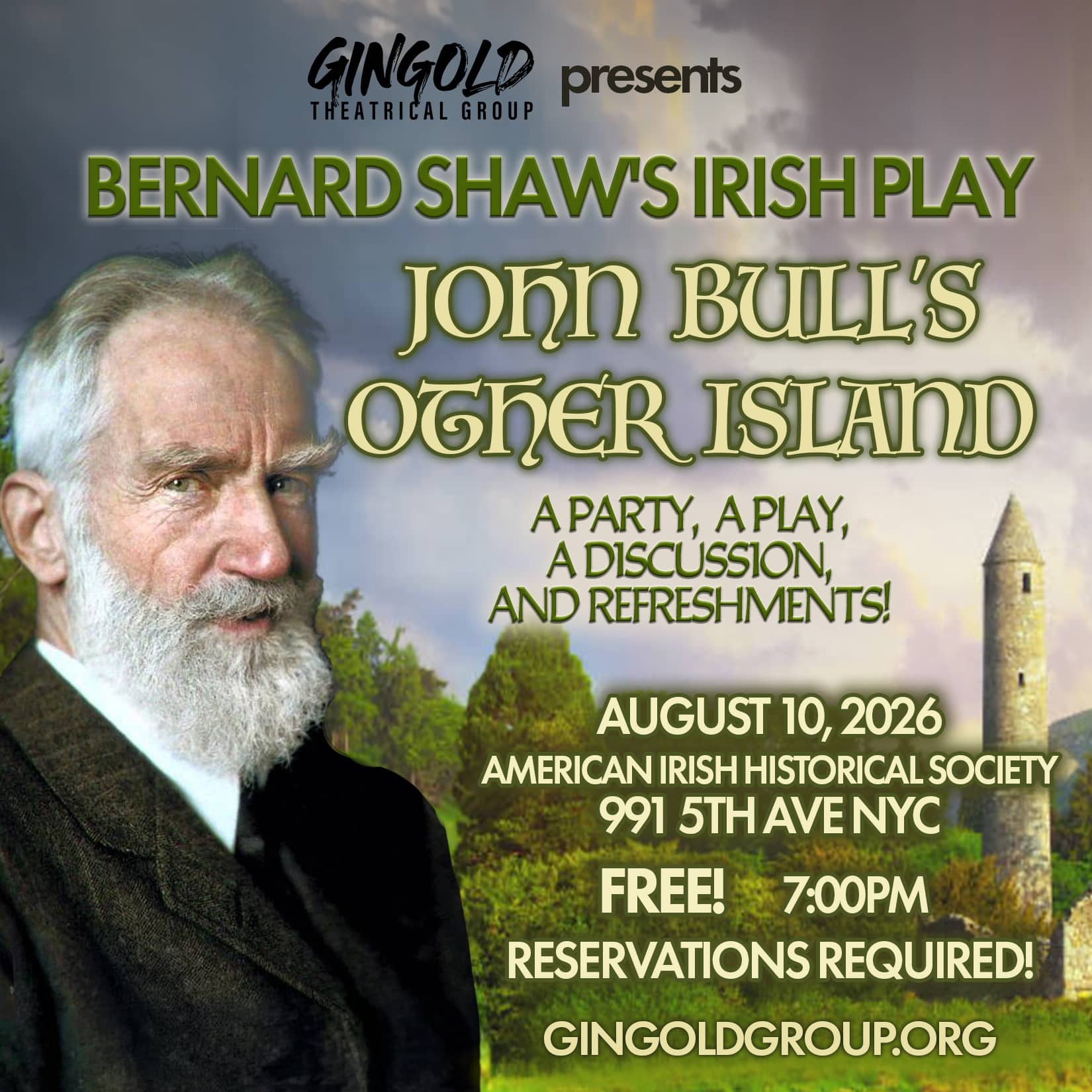
AUGUST 10
at 7:00 PM
IT’S A PARTY!
A play, A discussion, A cup of cheer!
Admission: Free and open to the general public (Reservations Required) PLEASE NOTE: ONE RESERVATION PER NAME!
Gingold Theatrical Group is proud to present a special reading and discussion of John Bull’s Other Island by George Bernard Shaw, in partnership with the American Irish Historical Society.
Written in 1904 at the request of W. B. Yeats for the Irish Literary Theatre (later the Abbey Theatre), the play is Shaw’s only work set in Ireland. It offers a witty and incisive exploration of the relationship between England and Ireland through the story of two business partners, an idealistic Englishman and a disillusioned Irish expatriate returning home for a land development scheme. With humor and precision, Shaw examines nationalism, identity, and cultural perception.
The evening will feature a Script-In-Hand performance with an All-Star-Cast, followed by a post-show discussion with artists and scholars exploring the play’s enduring themes of diaspora, cultural mythmaking, and Irish identity.
Our glorious cast and wild party guests:
Tom Broadbent—RODD CYRUS
Larry Doyle— A.J. SHIVELY
Keegan– ROBERT CUCCIOLI
Patsy Farrell— JAMIE SANDERS
Father Dempsey— RUFUS COLLINS
Corney (Cornelius) Doyle— GEORGE DVORSKY
Matthew Haffigan– JONATHAN HADLEY
Aunt Judy— KAREN ZIEMBA
Nora Reilly AMELIA PEDLOW
Grasshopper, Narrator, and Director – David Staller

JOHN BULL’S OTHER ISLAND by Bernard Shaw
Bernard Shaw may have left Ireland for London at the age of twenty, but Ireland never left Bernard Shaw. Its rebellious spirit, political contradictions, romantic mythology, and deep suspicion of the English imagination remained with him throughout his life. All of these collide—hilariously and provocatively—in John Bull’s Other Island.
Written in 1904 at the request of W. B. Yeats for the Irish Literary Theatre, soon to become the Abbey Theatre, the play proved to be more than Yeats had bargained for. Shaw’s Ireland was neither a poetic dreamland nor a shrine to heroic nationalism. It was a living country: practical and mystical, impoverished and ambitious, sentimental and unsentimental—often all at once. The theatre declined to produce it, and the play instead received its premiere at London’s Royal Court Theatre on November 1, 1904.
John Bull’s Other Island turns conventional ideas about English and Irish identity delightfully inside out. Tom Broadbent, an irrepressibly confident English businessman, arrives in Ireland and immediately falls in love with everything about it—or, more precisely, with his own romantic idea of it. His Irish business partner, Larry Doyle, returns home determined not to be seduced by the country he escaped. Broadbent sees poetry everywhere; Larry sees poverty, paralysis, and self-deception. Naturally, it is Broadbent who proves better equipped to succeed there.
Behind the comedy lies the urgent political question of Irish Home Rule. Shaw was skeptical of nationalism whenever patriotic feeling became a substitute for practical improvement. He distinguishes between those who dream about changing the world and those who possess the appetite—and sometimes the audacity—to act upon it. Yet he is too perceptive to offer a simple contest between foolish Englishmen and wise Irishmen. Everyone in the play sees part of the truth, and everyone is blinded by something.
The play became Shaw’s first major popular success. Politicians flocked to see it, including Prime Minister Arthur Balfour, who reportedly attended four times. King Edward VII requested a command performance and, according to theatrical legend, laughed so violently that he broke his chair. Whether every detail of the story is true hardly matters: Shaw had finally succeeded in making the British establishment laugh at a comedy about British power.
At the center of the play stands Peter Keegan, one of Shaw’s most mysterious and affecting creations. Neither conventional priest nor practical politician, Keegan sees possibilities invisible to everyone around him. His final vision lifts the play beyond political satire and into something stranger, more spiritual, and unexpectedly moving.
What fascinates me most is the journey each character takes. The outsiders disturb a village insulated from change; the villagers overturn the expectations of the outsiders; and everyone is compelled to make unfamiliar choices. Broadbent’s journey is both transparent and profound, while Keegan’s concluding speech is among the most thrilling Shaw ever wrote.
More than a century later, John Bull’s Other Island continues to ask uncomfortable questions: Who has the right to define a country? Do we love places as they are, or as we need them to be? When does national pride inspire progress—and when does it prevent it?
Following the performance, we invite you to remain for a conversation with our artists and guests about the play’s historical background, its contemporary resonance, and its continuing exploration of Irish identity, diaspora, nationalism, and cultural exchange. –David Staller